Sunday, June 7, 2009

The Green Hornet- Universal Serials

I've been a big fan of the cliffhanger serials of the 1930s/1940s for years, and these two are probably two of my favorites of the now defunct cinematic format....

The Green Hornet (1940) is a Universal movie serial based on the The Green Hornet radio series by George W. Trendle.

The Green Hornet, secretly newspaper publisher Britt Reid, and his Korean valet Kato stop and expose several seemingly separate crimes. This leads them into continued conflict with The Leader, the criminal mastermind behind The Syndicate and the individual crimes.

Download Links (Hosted by Internet Archive)


The Green Hornet Strikes Again (1941)
The Green Hornet and his sidekick Kato return to face Boss Crogan and his varied rackets across the city in The Green Hornet Strikes Again!


Download Link (Hosted by Internet Archive)

Monday, May 18, 2009

The Spirit Magazine #1 (1974, Warren Publishing)

I recently purchased and re-watched (I'd already caught it during it's theatrical run) Frank Miller's directorial effort, the film adaptation of Will Eisner's immortal THE SPIRIT...

While I'm still out on the fence as to what my opinion about Miller's movie is, I figured it'd be a good time to share how I discovered the character with my blog-reading friends...

Like many fans my age (who grew up in the late 1970s and 1980s), I first discovered both Eisner's work and his creation Denny Colt in the Warren Publications magazine of the mid-1970s.

Again, with the Wikipedia stuff:

Warren Publishing and later Denis Kitchen's Kitchen Sink Press published extensive reprints, first as large black-and-white magazines (the Warren part of the run eventually having a color section), then as trade paperbacks. The magazines often featured new Eisner covers.

Two new stories were written during this period "The Capistrano Jewels", a 4-page story published in the second issue of the Kitchen Sink reprints in 1972; and "The Invader", a 5-page story (reprinted in The Will Eisner Color treasury).

In 1976, an oddity called "The Spirit Casebook of True Haunted Houses and Ghosts" was published. The Spirit plays the EC host, introducing "true" stories of haunted houses. The Spirit makes a cameo in Vampirella #50.


Download Link (Hosted By MediaFire)
The Spirit Magazine #1 CBZ file

Tuesday, May 12, 2009

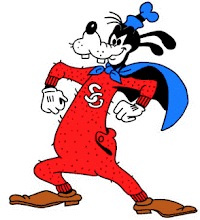
Super Goof #1 (Gold Key, 1965)


Being a big fan of the funny animal superhero parody/ satire, this book became a favorite during my youth. During the last few years, I've been working towards tracking down a complete run of all 74 issues. The final issue, #74, holds the distinction of being one of the last Disney licensed books that the great Dell/GoldKey/Whitman empire published prior to ceasing all comic book publication in April 1984.

From Wikipedia:

Super Goof (also Super Pippo) is a fictional character, the Disney character Goofy's superhero alter ego. He gets his power by eating Super Goobers (peanuts). His powers are similar to Superman's. Goofy became the first Disney character to get a career as a superhero, but several would follow — notably Donald Duck as Paperinik, whose reliance on gadgets and the night made him more of a Batman figure.

Super Goof first appeared in The Phantom Blot #2 (February, 1965) by Del Connell (story) and Paul Murry (art), where he was just imagining that he was a super hero. He made his first appearance as an actual superhero in Donald Duck #102 (July, 1965), in the story "All's Well that Ends Awful", also by Connell and Murry. In his third appearance, "The Thief of Zanzipar" from Super Goof #1 (October, 1965), the origin of his powers is meteor-irradiated peanuts. In later stories, Super Goof not only encountered the Phantom Blot, but also such adversaries as Black Pete, the Beagle Boys, Emil Eagle, and Mad Madam Mim.

Super Goof's secret identity is known only to his nephew Gilbert who also calls himself Super Gilly on occasion. His favourite "shout" is Ta-Dah. Comic relief in the stories would spring from the fact that Super Goof's powers would "wear off" at the least opportune moments, such as when he was flying or in need of super strength. Goofy always kept a few Super Goobers in his hat, but would occasionally forget to restock, leading to situations in which he would have to get out of trouble without the super powers. In a crossover story, Huey, Dewey and Louie found a Super Goober plant sprouted by a dropped goober, and "borrowed" Super Goof's powers; after doing a round of super deeds, the ducks' powers faded, and they had to be rescued by the Junior Woodchucks.

Super Goof had his own comic book series from 1965 to 1984 with a 74-issue run from Gold Key Comics. Reprints appeared in Walt Disney Comics Digest, one of the Dynabrite deluxe comics issued by Western in the late 1970s, and Disney Comic Album #8 (1990) from Disney Comics. The first release in the German-language Heimliche Helden book series by Ehapa published Oct. 2005 was devoted to Super Goof. Gemstone reprinted a story drawn by Jack Bradbury for the Studio Program as a backup in their 2006 release Return of the Blotman with the rescripting handled by longtime Super Goof aficionado Joe Torcivia. He also appeared in one episode of House of Mouse.


Download Link (Hosted by Rapidshare)

Super Goof #1 CBR file

Saturday, May 2, 2009

In Search of Steve Ditko- BBC Documentary


Excellent BBC production hosted by Jonathan Ross...I absolutely adore the Alan Moore interviews....

I've been a HUGE Ditko fan since discovering his work as a child in the Marvel reprint title Marvel Tales during a period in the early 1980s in which they were reprinting the entire Lee/Ditko run of Amazing Spider-Man....


Download Links (Hosted By Rapidshare)

Part 1
Part 2
Part 3
Part 4
Part 5
Part 6
Part 7
Part 8

Monday, April 27, 2009

The Fantastic Four Radio Show (1975)


• 01 - Fantastic Four meets the Mole Man
• 02 - Menace of the Miracleman
• 03 - Coming of the Submariner
• 04 - Dreaded Dr Doom
• 05 - Prisoners of the Puppet Master
• 06 - Fantastic Four meet the Incredible Hulk

Download Link (Hosted by Megaupload)
FF Radio Show Ep. 1-6


• 07 - Spell of the Hate Monger
• 08 - Return of Dr Doom
• 09 - In the Clutches of Dr Doom
• 10 - Super Skrull Walks Among Us
• 11 - At the Mercy of the Red Ghost
• 12 - Menace of the Red Ghost
• 13 - Submariner Strikes

Download Link (Hosted by Rapidshare)
(Link down....coming back soon)

Sunday, April 26, 2009

The Conquerer (Dell Movie Classics #690, 1956)


WTF?!? John Wayne as Genghis Khan?!? UNINTENTIONAL COMEDY GOLDMINE! Plus, the backstory and the aftermath of the filming is a priceless bit of madness...

Take it away, Wikipedia:


The Conqueror is a 1956 CinemaScope epic film produced by Howard Hughes and starring John Wayne as the Mongol conqueror Genghis Khan. Other performers included Susan Hayward, Agnes Moorehead, and Pedro Armendáriz. The picture was directed by actor/director Dick Powell. The film was principally shot near St. George, Utah.

The picture was a critical and commercial failure (often ranked as one of the worst films of the 1950s), which is remarkable given the stature of the cast. Wayne, who was at the height of his career, had lobbied for the role after seeing the script and was widely believed to have been grossly miscast. (He was so "honored" by The Golden Turkey Awards.)

Reportedly, Howard Hughes felt guilty about his decisions regarding the film's production (see Cancer controversy below) and kept the film from view until 1974 when it was first broadcast on TV. The Conqueror, along with Ice Station Zebra, is said to be one of the films Hughes watched endlessly during his last years.


The exterior scenes were shot on location near St. George, Utah, 137 miles downwind of the United States government's Nevada Test Site, Operation Upshot-Knothole, where extensive above-ground nuclear weapons testing occurred during the 1950s. The cast and crew spent many difficult weeks on the site. In addition, Hughes later shipped 60 tons of dirt back to Hollywood for re-shoots. The cast and crew knew about the nuclear tests, there are pictures of Wayne holding a Geiger counter during production, but the link between exposure to radioactive fallout and cancer was poorly understood then.

Powell died of cancer in January 1963, only a few years after the picture's completion. Hayward, Wayne, and Moorehead all died of cancer in the mid to late 1970s. Cast member actor John Hoyt died of lung cancer in 1991. Pedro Armendáriz was diagnosed with kidney cancer in 1960 and committed suicide after he learned it was terminal. Skeptics point to other factors such as the wide use of tobacco— Wayne and Moorehead in particular were heavy smokers — and the notion that cancer resulting from radiation exposure does not have such a long incubation period. The cast and crew totaled 220. 91 developed some form of cancer by 1981 and 46 had died of it by then. Dr. Robert Pendleton, professor of biology at the University of Utah, stated, "With these numbers, this case could qualify as an epidemic. The connection between fallout radiation and cancer in individual cases has been practically impossible to prove conclusively. But in a group this size you'd expect only 30 some cancers to develop...I think the tie-in to their exposure on the set of The Conqueror would hold up in a court of law."


Download Link (Hosted by Internet Archive)

Dell Movie Classics #690 CBR file

Monday, April 20, 2009

Pulp Heroes: Justice, Inc. (DC Comics)


I've held a long-time fascination with the pulp and radio heroes of the 1930s and '40s, for which I have my paternal grandmother and aunt to blame for. Now, hindsight is probably heavily embellished, so forgive any discrepancies that might follow, but as a small child with both parents working...I spent several afternoons with the two above-mentioned women pre-kindergarten in a household that still held to the values that the television was a device that shouldn't be turned on until 6 p.m. at the least. Hell, the first color set my grandmother ever owned was purchased by my father after my grandfather's death....in 1991.

So, to keep me occupied as a wee lad, my grandmother, who was a HUGE fan of radio drama during it's hey-dey, would literally (and remember what I said earlier about hindsight) verbally relate episodes of her favorite shows to me, verbatim. It wasn't until I was probably around the age of 6 or 7 that I came to the realization that The Shadow, The Green Hornet, Fibber McGee (and Molly), Amos n' Andy, and a whole slew of fictional characters were just that: fictional. I just thought they were folks that grandma knew....

So, when I came to discover that there were comic books produced about these heroes, it's a no-brainer I would take an interest. One of the first I came to discover during those early years of collecting in the early 1980s was what would become quite possibly one of my favorite DC Comics series of all time, Denny O'Neil and Mike Kaluta's excellent interpretation of The Shadow.

At some point later, while in high school, I would disocver Walter Gibson's other work, The Avenger, via ancient Bantam paperback reprints from the early 1970s and the short-lived DC Comics series Justice, Inc.....

I lucked into an entire run of the 1970s DC title around that time. I actually like the latter half of the book in which Jack Kirby was handed the reigns on the character...


Around this time, in the early 1990s, DC revisited the character (for much the same reasons they did took any interest the first time: they were experiencing some success with a new book based upon the more popular Lamont Cranston, The Shadow) in a two issue prestige format mini-series illustrated by one of my favorite artists, Kyle Baker. This take learns more towards the Avenger being involved in shadowy covert operations during the Cold War, but is still an interesting read...


Download Links (Hosted by Rapidshare and Mediafire)

Justice Inc #1-#4 (first series) RAR file

Justice Inc #1-#2 (second series) RAR file